Is America’s Baby Bust an Illusion?
Vantage Point: Mini briefs from the Global Aging Institute in partnership with The Terry Group and Athena Actuarial Consulting
May 7, 2026

The U.S. total fertility rate (TFR) has fallen in nine of the past ten and sixteen of the past eighteen years. Yet there are some who maintain that U.S. birthrates are not in long-term decline, or at least that the decline is not nearly as deep as the collapse in the TFR would suggest. In this Vantage Point, we explain why those who believe that America’s baby bust is just a statistical illusion are almost certainly mistaken.
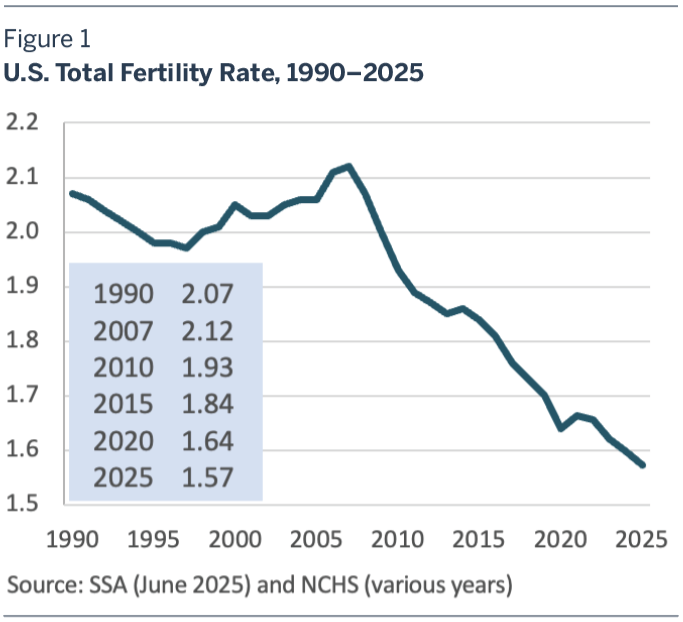
America’s baby bust continues to deepen. According to provisional data from the National Center for Health Statistics (NCHS), the U.S. total fertility rate (TFR), a measure of average lifetime births per woman, sank to a new historical low of 1.57 in 2025, down from 2.12 in 2007 just before the baby bust began. That now makes nine of the past ten years and sixteen of the past eighteen years that the TFR has fallen.
Yet despite what would seem to be a clear trend, there are some who maintain that U.S. birthrates are not in long-term decline, or at least that the decline is not nearly as deep as the collapse in the TFR would suggest. This has long been the view of the Social Security Administration. A number of recent media stories in prominent publications, including The Economist and the New York Times, have also tried to make the case that the baby bust is little more than a statistical illusion.1
In this Vantage Point, which updates and expands an earlier issue entitled “America’s Deepening Baby Bust” (May 15, 2024), we examine the evidence—and explain why those who believe that America’s baby bust is an illusion are almost certainly mistaken.
A Trivial Tempo Effect
Let’s start with the trend in the TFR, which no one disputes. For nearly two decades prior to the Great Recession, the U.S. TFR hovered between 2.0 and 2.1, roughly the “replacement rate” needed to maintain a stable population from one generation to the next. Since then it has been in almost continuous decline, dropping from 2.12 in 2007 to 1.57 in 2025, or by one-quarter.2 (See figure 1.)
What is in dispute is whether the decline in the TFR portends a decline in completed cohort fertility. The completed cohort fertility rate—that is, the average number of children that a birth cohort of women have over their lifetimes—is what ultimately determines America’s long-term demographic trajectory. But since this rate cannot be known until women have reached the end of their childbearing years, demographers also calculate a current or “period” measure of fertility called the TFR. This measure, which sums up age-specific birthrates in a given year, assumes that women, as they progress through their childbearing years, will at each age have children at the same rate that women are now having children at that age.
If age-specific birthrates remain constant over time, period and cohort measures of fertility will closely track each other. But if women shift the timing of their births, the two measures will diverge. Those who question whether the decline in the TFR is meaningful argue that young women are postponing family formation until later in life (a tempo effect) rather than deciding to have fewer children (a quantum effect), and that birthrates will eventually rise enough at older ages to push the TFR back up.
It is well known that tempo effects have sometimes depressed the TFR in the past. As the Baby Boom generation came of age starting in the mid-1960s, the U.S. TFR plunged from 2.7 in 1966 to 1.7 in 1976. But by the 1990s, as late-birthing Boomers began to have children in larger numbers, it partially recovered to the 2.0 to 2.1 range. When, in the wake of the Great Recession, it first became apparent that the TFR was once again declining, it seemed reasonable to assume that Millennials, like Boomers before them, were pushing out childbearing until later in life and that the TFR would soon rise again.
Yet what once seemed reasonable no longer does. Nearly twenty years have passed since America’s current baby bust began, and the oldest Millennials are now reaching the end of their childbearing years. Yet far from being higher than it was in 2007, the birthrate of women in their early thirties is actually slightly lower. And though the birthrates of women in their late thirties and early forties have risen, the increases are far too small to make up for the enormous declines in birthrates among women in their teens and twenties. (See figure 2.)
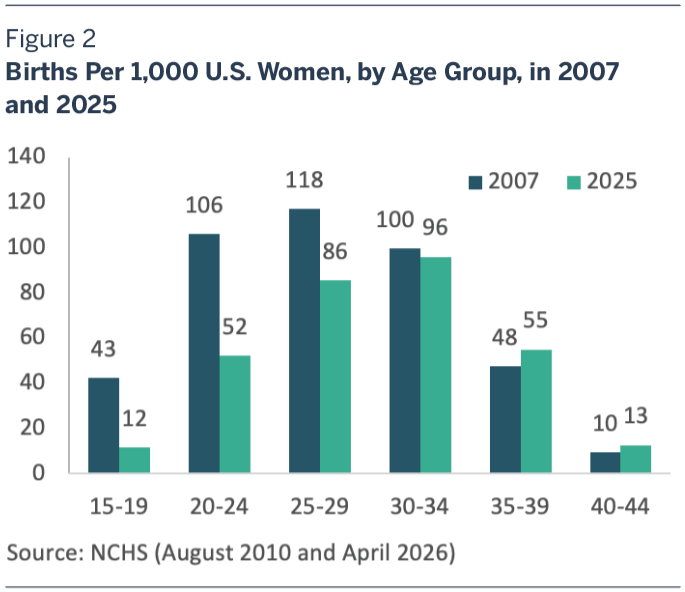
It is worth focusing a moment on this last point. Any casual reader of the New York Times article, with its highly misleading presentation of the data, could be forgiven for concluding that the increase in birthrates since 2007 among women over 35 has largely offset the decline in birthrates among women under 35. But this is simply not the case. In fact, the increase has offset less than 10 percent of the decline. Yes, this is technically a tempo effect, but it is a trivial one.
It is true that completed cohort fertility has so far remained steady at around 2.0, even as the TFR has fallen. But the main reason for this, contrary to what both The Economist and New York Times articles suggest, is not that women now ending their childbearing years recouped births in their thirties and forties that they didn’t have in their teens and twenties. The main reason is that women now ending their childbearing years began them in the late 1990s when birthrates at younger ages were much higher than today.
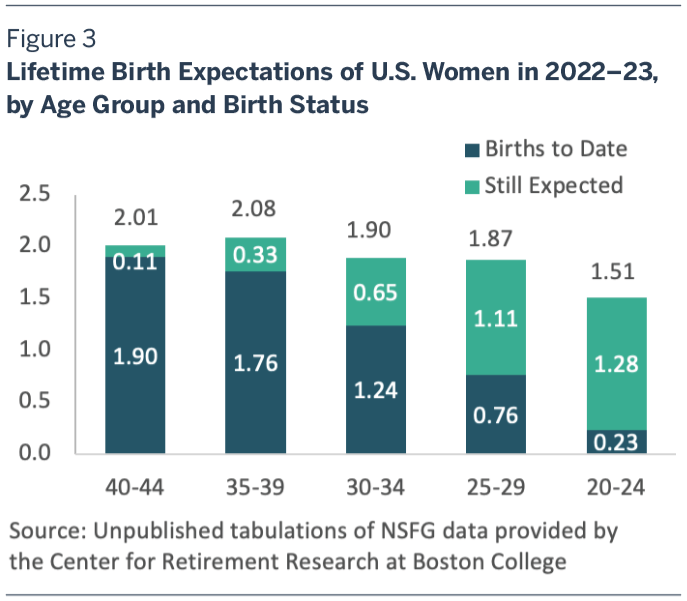
The latest data on birth expectations from the National Survey of Family Growth (NSFG) provide a better indicator of where things are heading. While total births (births to date plus births still expected) averaged 2.01 for 40–44 year-olds in the latest 2022–23 survey, the total has sunk to just 1.51 for 20–24 year-olds. (See figure 3.) Historically, moreover, birth expectations have usually turned out to be overly optimistic.3 In short, far from overstating the depth of America’s baby bust, the TFR may be understating it.
A More Normal Developed Country
It is tempting to think that America’s baby bust is an aberration and that the TFR will necessarily climb back to its higher pre-Great Recession level. But in fact it was the higher level that was the aberration. Between 1990 and 2010, the U.S. TFR exceeded that of every other developed country except Iceland, Israel, and New Zealand. Today, it is about equal to the OECD average. When it comes to fertility behavior, America has simply become a more normal developed country in which delayed marriage, delayed childbearing, and smaller family size are the norm.
It is hard to see what might change this anytime soon. The decline in the U.S. TFR has been broad-based, encompassing Americans of all races and ethnicities. Moreover, none of the social and economic trends that have helped to depress birthrates show signs of reversing. The age of first childbirth continues to rise in tandem with female educational attainment. Religiosity, which is highly correlated with fertility, may no longer be falling but remains far beneath historical levels. At the same time, it continues to be much more difficult for Millennials and Zoomers to launch careers and establish independent households than it was for Boomers and Xers at the same age.
To be sure, demographers have sometimes been surprised by unexpected shifts in fertility behavior. Few if any predicted the postwar Baby Boom, and few if any predicted its end. Yet the purpose of demographic projections is not to anticipate the unknowable, but to show where current trends are leading us. Absent a crystal ball, it seems prudent to assume that fertility will remain low for the foreseeable future.
The UN Population Division, whose latest projections assume that the U.S. TFR will average 1.64 over the rest of the century, clearly agrees. So do the Census Bureau and the Congressional Budget Office, whose latest projections assume, respectively, that it will average 1.59 and 1.54. Only the Social Security Administration, whose 2025 Trustees’ report assumes that the TFR will rise back to 1.90, continues to believe that a large and much delayed tempo effect will finally kick in.
America’s baby bust has profound implications for the future. The U.S. population will age much more than would otherwise have been the case and, even with substantial immigration, may begin to contract. Fiscal burdens will rise and economic growth will slow. Since national power depends critically on fiscal and economic capacity, even America’s geopolitical stature may diminish.
Pretending that the baby bust isn’t real won’t change the outcome. It will just delay the required policy adjustments and make them more painful than they need to be.

About Vantage Point
Vantage Point is a sister publication of Critical Issues. Both publications explore the demographic and economic trends reshaping America and the world, and in particular the future environment for retirement and health care. While Critical Issues offers in-depth analyses of these trends, Vantage Point features mini briefs on important new developments.
Project Supervisor
Tom Terry, CEO, The Terry Group
Series Author
Richard Jackson, President, the Global Aging Institute (GAI)